BPA Writing Curriculum
At Bluecoat Primary Academy, part of Archway Learning Trust, we believe that every child should learn to write with confidence, skill and enjoyment. Writing is not only a vital tool for communication – it is a powerful way for children to express their ideas, imagination and individuality.
Our goal is for all pupils to:
- Write clearly, confidently and creatively
- Use writing for communication and for pleasure
- Develop their own authorial voice
- Understand that writing can influence, inform and inspire others
Curriculum Design
Our writing curriculum is carefully planned to help children grasp both the mechanics of writing (transcription) and the craft of writing (composition). We draw on research from the DfE Writing Framework, Ofsted guidance, and the EEF, ensuring our approach is both evidence‑based and effective.
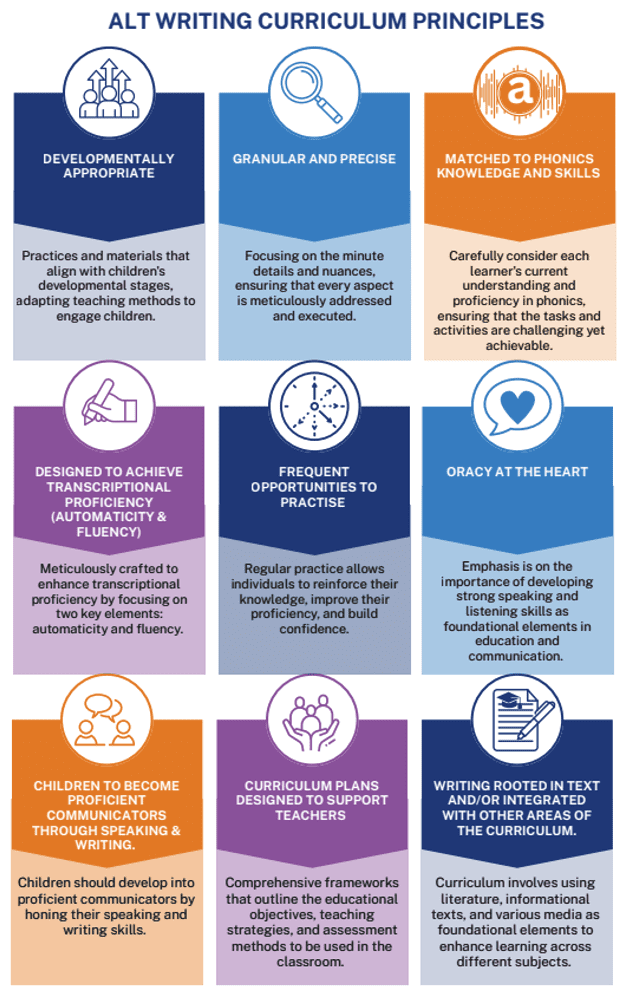
Our writing curriculum has been underpinned by the following nine principles:
To help children become confident, effective writers, we place a strong focus on transcription (handwriting and spelling) in EYFS and Key Stage 1. By securing these skills early, we reduce cognitive load so children can concentrate on their ideas. Pupils rehearse sentences aloud and use dictated sentences to apply what they know. As handwriting and spelling becomes increasingly fluent and automatic, the focus gradually shifts to composition – learning how to structure different text types, build accurate sentences and use correct punctuation. Children are taught to evaluate, edit and revise their writing so it is coherent, accurate and has impact on the reader.
Expectations of English Curriculum
Across all year groups, children receive a daily English lesson, alongside a daily discrete handwriting lesson and a daily phonics or spelling lesson appropriate to their stage of learning. In addition, every year group has a dedicated reading lesson, taught separately from the English lesson, to ensure consistent development of decoding, comprehension and reading fluency.
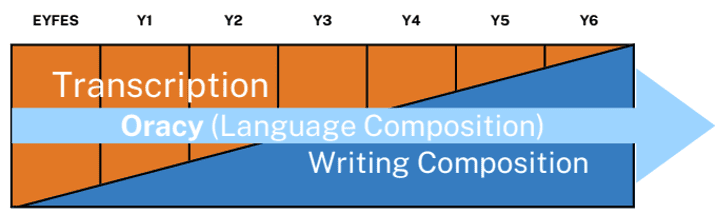
Oracy at the heart of our curriculum
We place spoken language at the centre of every writing unit.
Through discussion and oral rehearsal, children learn to:
- Explore ideas before writing
- Develop a rich vocabulary
- Rehearse sentences aloud
- Become confident, capable communicators
- Strong oracy supports strong writing — and we prioritise both.

Sequence of Lessons
Every writing unit follows the same consistent structure, helping children understand writing as a process:
- Engage and Immerse
Children are introduced to the text type through exciting hooks and high‑quality model texts. This builds understanding and enthusiasm.
- Learn the Skills
Grammar, punctuation and sentence‑level skills are taught explicitly. Children practise these through short, purposeful writing tasks.
- Planning
Pupils plan their ideas with the audience and purpose in mind. As they move through school, planning becomes increasingly detailed and independent.
- Drafting
Children draft their writing using oral rehearsal, teacher modelling and guided feedback. They learn to make thoughtful choices about vocabulary, structure and tone.
- Editing and Improving
Children evaluate, edit and refine their work using taught strategies to ensure clarity, accuracy and impact.
- Publishing and Sharing
Pupils present their final piece and share it with the intended audience. This stage helps them feel pride and ownership over their writing.
Throughout all stages, spoken language is essential — children learn to talk as writers before they write as writers.
Writing Progression
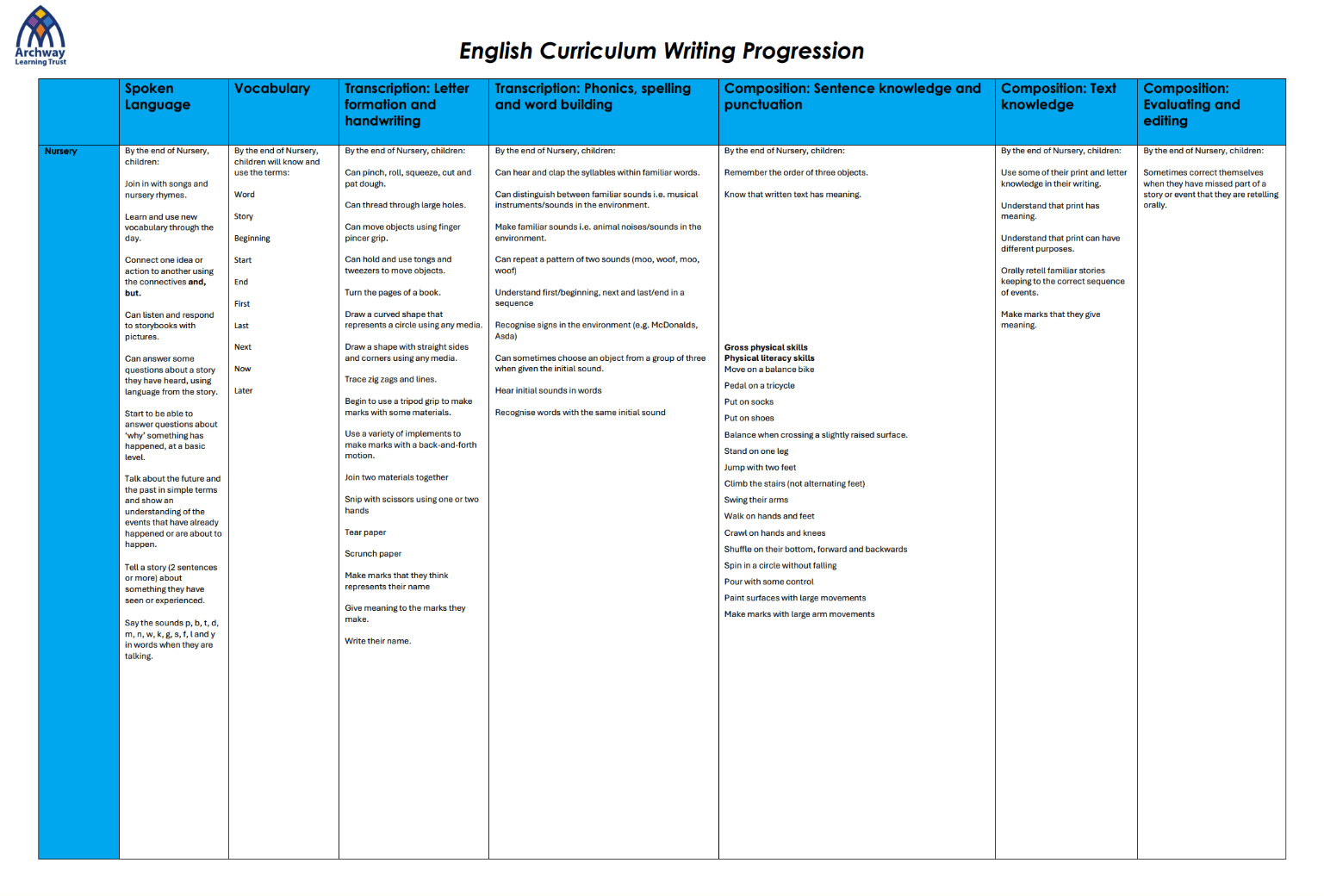
The Writing progression of knowledge document provides a clear roadmap for skill development, ensuring students build on foundational skills progressively. It ensures that pupils revisit and review key grammatical skills whilst also introducing new content at an appropriate time. This progression across year groups, aids smooth transitions and prevents learning gaps.

If you are interested in finding out more about our writing curriculum, please contact our English Leader, Miss Horridge.